Opening a New Research Direction in Green Light Signal Regulation of Plant Development
Light is essential for plants, yet green light, which constitutes more than half of visible light energy, has long been marginalized in light signal research due to the fact that most of it is reflected by leaves. In common perception, green light seems “useless” to plants. While some studies have suggested that green light can regulate plant growth and development, their results are often contradictory. These inconsistencies largely stem from limitations in light source technology—commercial green LEDs inevitably emit residual blue or red light, which significantly interferes with experimental results.
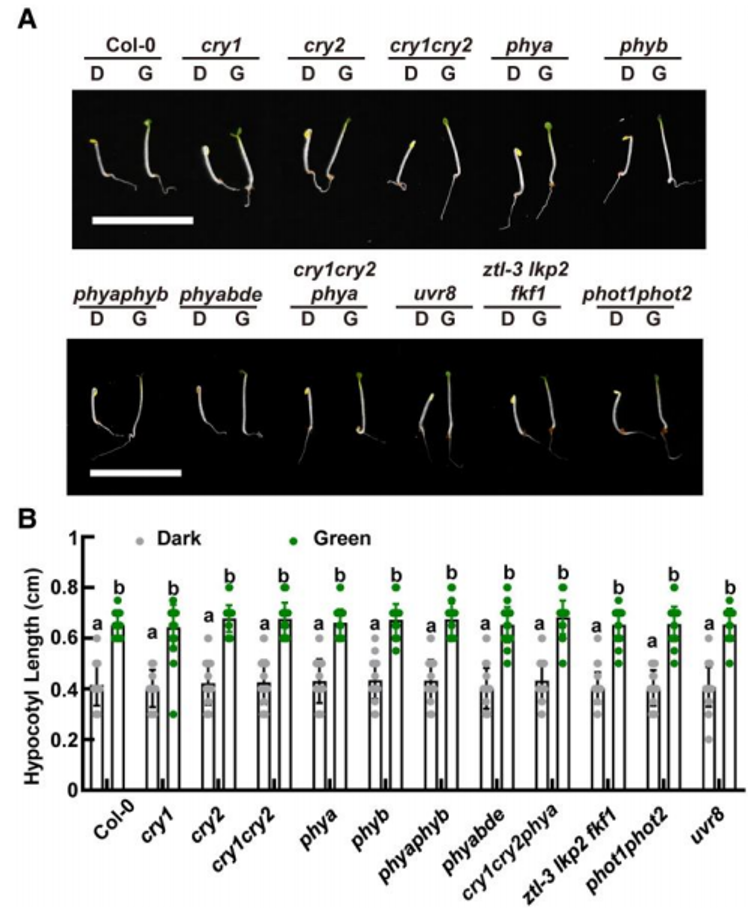
To address this issue, our research group developed a pure green light source by pairing green LEDs with carefully selected optical filters. Under this controlled light condition, we discovered that green light indeed promotes hypocotyl elongation in Arabidopsis seedlings. Furthermore, we confirmed that none of the known plant photoreceptors can act as green light receptors mediating this phenotype.
Omics analyses revealed a connection between green light signaling and the brassinosteroid signaling pathway. Specifically, BES1, a key transcription factor in the brassinosteroid pathway, exhibits enhanced DNA-binding activity under green light. This, in turn, regulates downstream gene transcription and promotes hypocotyl elongation.
Our precise use of optical filters has paved the way for groundbreaking research into green light signaling, challenging traditional views and opening new avenues to understand its role in plant development.